Direct admission in Colleges in India 2026 explained with fees, process, risks & safe strategy. Read before choosing any college and avoid costly mistakes.
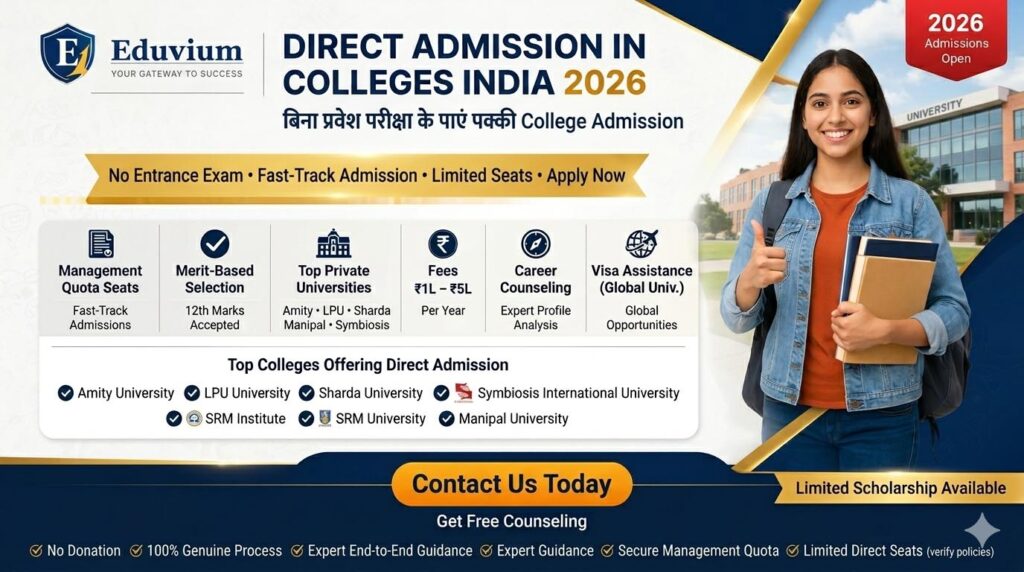
If you’re planning for college admission in 2026 and wondering whether you can get admission without entrance exams, the answer is yes—but it’s not as simple or as safe as it sounds.
In India, direct admission has become a common pathway, especially in private and deemed universities. But most students misunderstand it. Some think it’s an easy shortcut, while others blindly trust agents or random colleges—both of which can lead to poor decisions.
The truth is simple:
Direct admission can be a smart move—but only when you understand how it actually works and choose carefully.
Direct admission in India means getting a college seat without going through national-level entrance exams like JEE Main or CUET, usually through private universities, deemed institutions, or management quota.
But here’s the critical part—
Not all direct admissions are equal.
Some are:
- Fully legitimate and structured
- Offered by recognized institutions
While others can be:
- Overpriced
- Low in academic value
- Or risky if not verified properly
That’s why this guide is not just about “how to get admission.”
It’s about helping you understand:
👉 What is safe, what is risky, and what is actually worth your money and time.
Table of Contents
How Direct Admission Works in Real Life (What Actually Happens)
In reality, direct admission does not begin with filling out a form—it begins much earlier, with the decision of choosing the right college. This is the stage where most students make mistakes, because instead of researching properly, they rush into options that simply offer easy admission. The truth is that the quality of your shortlist determines the quality of your outcome, not the ease of the process.
1. It starts with shortlisting the right colleges.
Before applying anywhere, students should compare multiple colleges based on placements, faculty, infrastructure, and recognition. Skipping this step often leads to poor decisions. A wrong shortlist cannot be fixed later, no matter how smooth the admission process looks.
2. Application is done directly through the college.
Once shortlisted, the application process is straightforward. Students apply through the official college website, submit their academic details, and upload required documents. There is no centralized counselling involved, which means you are dealing directly with the institution, not a system or third party.
3. The college evaluates your eligibility.
After applying, the college reviews your profile, usually based on Class 12 marks and basic eligibility criteria. Some institutions may include interviews or internal screening, but there is no competitive ranking like exams such as JEE Main or CUET. This makes admission easier, but also increases the importance of choosing the right college.
4. Admission offer is issued.
If you meet the criteria, the college provides an offer letter or confirmation. This step should never be taken lightly. Every admission offer must be verified properly, and students should ensure all details are clear before proceeding further.
5. Payment confirms your seat.
The final step is fee payment, which officially secures your admission. This is also the most sensitive stage of the entire process. Payments should always be made to the official college account, and proper receipts must be collected. Any request for cash payments or personal accounts is a serious red flag.
6. Understanding the hidden reality of the process.
What makes direct admission confusing is that the process looks almost identical across all colleges. Whether the institution is excellent, average, or poor, the steps remain the same. This creates a false sense of security. In reality, the process may be similar, but the outcomes can be completely different.
7. The role of agents should be limited.
Many students involve agents or consultants, which can sometimes create unnecessary risk. While basic guidance is acceptable, complete dependence is not. Students must always verify information directly from the college. Your admission decision should never be controlled by a third party.
In the end, the process itself is simple and structured. The real challenge lies in decision-making. Getting admission is easy—getting the right admission is what truly matters.
Real Cost of Direct Admission in 2026 (Clear + Optimized Breakdown)
Understanding the cost of direct admission is critical, because this is where most students either overpay or make rushed decisions. Unlike entrance-based admissions, there is no universal fee structure, which makes clarity even more important.
1. Cost varies based on the type of institution.
In private universities, fees are usually structured and publicly defined. For most undergraduate programs like B.Tech, BBA, or BCA, the annual fee typically ranges between ₹80,000 to ₹3,00,000, depending on infrastructure, brand value, and placement support. Higher-ranked private institutions may charge more, but they also tend to offer better exposure.
Deemed universities generally operate in a higher fee bracket. Their annual cost often falls between ₹1,50,000 to ₹5,00,000, especially for professional courses. Over the full duration, this becomes a significant investment.
👉 The stronger the brand and outcomes, the higher the cost—but not always justified.
2. Management quota creates the highest price variation.
This is the least transparent part of direct admission. Fees here are not always standardized and may include higher tuition or one-time seat confirmation charges.
Typical total ranges:
- B.Tech: ₹2L to ₹10L+
- MBA: ₹5L to ₹20L+
- MBBS: ₹50L to ₹1Cr+
👉 Wide variation = high need for verification
3. Total cost is always higher than advertised fees.
Students often focus only on tuition, but actual expenses include:
- Hostel and accommodation
- Examination and academic charges
- Miscellaneous institutional fees
Over 3–4 years, this can increase the total cost significantly.
👉 Always calculate full program cost, not yearly fee
4. High fees do not guarantee quality.
One of the biggest myths is that expensive colleges automatically provide better education or placements. In reality, some institutions charge high fees due to demand or marketing—not outcomes.
👉 Price ≠ Placement quality
5. Low fees are not always a bad sign.
Some lesser-known colleges offer decent education at reasonable costs. These can be good options if verified properly.
👉 Value matters more than branding
6. Unclear or flexible pricing is a red flag.
If fees are:
- Changing frequently
- “Negotiable”
- Not mentioned on official platforms
then it indicates lack of transparency.
👉 Fixed and published fees = safer choice
7. Payment process defines safety.
Even a good college can become risky if the payment process is unclear. Always ensure:
- Payment is made to official account
- Proper receipt is provided
👉 No receipt = no security
8. Focus on return, not just cost.
The most important question is not how much you are paying, but what you are getting in return.
👉 Ask: Will this college justify my investment in terms of skills and placements?
Final Clarity
👉 Direct admission cost is flexible—but your decision should be based on value, transparency, and long-term return, not just affordability.
Who Should Choose Direct Admission (Critical Decision Guide)
Choosing direct admission is not about availability—it is about suitability. The same option can be a smart decision for one student and a poor choice for another. That’s why understanding where you stand is more important than understanding the process.
1. It works best for students who want to avoid a drop year.
If you have already attempted entrance exams and did not achieve the desired result, but you are not willing to spend another year preparing, direct admission can be a practical way forward. Instead of delaying your academic journey, you can move ahead with a decent college and focus on skill development.
👉 Saving one year can be valuable—if the college is worth it
2. It suits students with average academic performance.
Not every student performs well in competitive exams like JEE Main or CUET. If your scores are moderate but you still want a stable and structured academic path, direct admission provides that opportunity.
👉 Direct admission reduces competition—but not responsibility
3. It is a good option when you have clear career direction.
Students who already know what they want to study and why they want to study it can benefit from starting early. In such cases, choosing a suitable college and focusing on internships, projects, and practical exposure can be more valuable than chasing ranks.
👉 Clarity of goal makes direct admission more effective
4. It requires financial readiness.
Since many direct admission options—especially in private or management quota seats—are more expensive, this route works better for students who can afford the cost without creating long-term financial pressure.
👉 Affordability should not become future stress
5. It is not ideal for students who can significantly improve.
If you believe that with one more attempt you can achieve a much better rank and get into a higher-quality college, then rushing into direct admission may limit your opportunities.
👉 Short-term relief can lead to long-term compromise
6. It is risky for students without career clarity.
If you are unsure about your course or career path, direct admission can lock you into a direction without proper thought. This often leads to dissatisfaction later.
👉 Confusion + quick admission = wrong decision
7. It should never be chosen just because it is “easy.”
One of the biggest mistakes students make is choosing direct admission simply because it avoids exams. Ease should never be the deciding factor in education.
👉 Easy entry does not guarantee a strong future
Final Clarity
👉 Direct admission is a strategic choice—it works only when it matches your goals, ability, and financial situation.
Step-by-Step Safe Process for Direct Admission (Final Action Plan)
By now, you understand the reality, cost, and risks. The final step is knowing exactly how to take direct admission safely and correctly, without confusion or mistakes.
1. Start with clarity, not urgency.
Before looking at colleges, be sure about your course and career direction. Many students rush into admission just to secure a seat, but clarity should always come before action.
👉 Right decision starts with clear intent
2. Shortlist colleges based on quality, not availability.
Do not search for “where admission is easy.” Instead, compare colleges based on placements, faculty, infrastructure, and recognition.
👉 Easy admission does not mean good education
3. Verify approvals and credibility.
Always check whether the college is approved by bodies like University Grants Commission or All India Council for Technical Education. This step alone removes many risky options.
👉 Verification is non-negotiable
4. Apply only through official channels.
Use the college’s official website or admission office. Avoid relying completely on agents or third-party platforms.
👉 Direct source = safer process
5. Confirm admission details before payment.
Ensure you receive proper admission confirmation or offer letter. Check all details carefully before proceeding.
👉 Never pay without written confirmation
6. Make secure and traceable payments.
Always pay to the official college account and collect a proper receipt. Avoid cash payments or personal accounts under any circumstances.
👉 Payment security defines your safety
7. Compare before finalizing.
Even if one option looks good, compare at least 2–3 colleges before making a final decision. This helps you avoid missing better opportunities.
👉 Comparison leads to better decisions
Final Verdict (What You Should Remember)
Direct admission is not a shortcut, and it is not a bad option either. It is simply a different pathway, and its success depends entirely on how you use it.
If you choose carefully, verify everything, and focus on long-term value, it can be a smart and practical decision. Many students build successful careers through this route without appearing for exams like JEE Main or CUET.
But if you rush, skip research, or trust the wrong sources, the same decision can lead to poor outcomes.
👉 Yes, direct admission works—if you choose carefully.
👉 No, it fails—if you choose quickly.
Final Insight
👉 Your career is not decided by how you enter college, but by the quality of the college you choose and what you do after entering it.
Read this also:
- How to Choose the Right Career Stream After 12th (Complete Decision Guide for Students)
- Top Colleges in India 2026: Best MBA, Engineering, Law & Medical Colleges
- CUET vs JEE Preparation Strategy: Which Exam Should You Focus On in 2026?
❓ Frequently Asked Questions (FAQs)
1. What is direct admission in colleges in India?
Direct admission means getting admission into a college without appearing for national-level entrance exams like JEE Main or CUET. It is usually offered by private universities, deemed institutions, or through management quota seats.
2. Is direct admission legal in India?
Yes, direct admission is completely legal in India. It is a recognized admission method, especially in private and deemed universities. However, students must ensure that the college is approved by authorities like University Grants Commission or All India Council for Technical Education.
3. Can I get admission without entrance exam in India?
Yes, many colleges in India offer admission without entrance exams. Private universities and some deemed institutions provide admission based on Class 12 marks or internal evaluation processes.
4. What is the fee for direct admission in India?
The fee for direct admission varies depending on the course and college. It can range from around ₹80,000 per year in private universities to ₹1 crore or more for medical courses under management quota.
5. What is management quota in college admission?
Management quota is a system where a certain percentage of seats in private colleges are reserved for direct admission. These seats are filled by the institution and usually involve higher fees compared to regular admission.
6. Is direct admission a good option for students?
Direct admission can be a good option if you choose a recognized college with good academic quality and placement support. However, it requires careful research and should not be chosen just for convenience.
7. How can I avoid scams in direct admission?
To avoid scams, always verify the college’s approval, apply through official channels, and make payments only to the college’s official account. Avoid agents who promise guaranteed admission or ask for urgent payments.
8. Which colleges offer direct admission in India?
Many private universities and deemed institutions offer direct admission. However, students should verify recognition, placement records, and overall quality before applying.
9. Is direct admission better than entrance exam admission?
Direct admission is not necessarily better or worse—it depends on the college you choose. Entrance exam admission may provide access to top government colleges, while direct admission offers flexibility in private institutions.
10. Can I get good placement through direct admission colleges?
Yes, placements depend on the college, not the admission method. A good private university can provide strong placement opportunities even through direct admission.