
Feeling Confused After 12th? Here’s the Exact Way to Choose the Right Career Path.
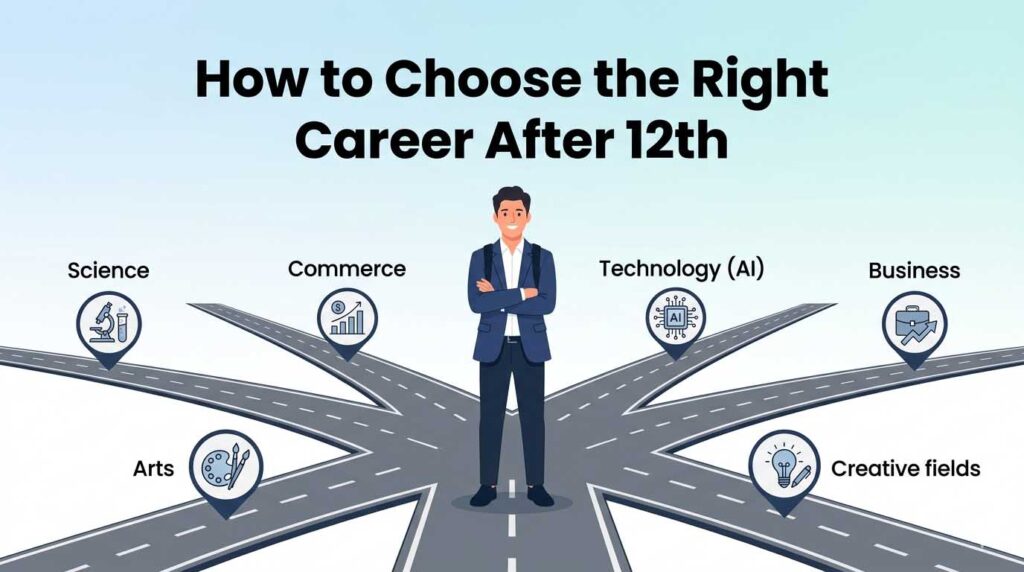
After completing 12th grade, most students stand at a life-changing crossroads—but instead of clarity, what they often feel is confusion, pressure, and fear of making the wrong decision. Some are influenced by family expectations, others follow friends, and many simply choose what seems “safe” or “popular.” The result? Years later, they realize they are stuck in a career that doesn’t excite them.
The truth is simple but powerful—choosing the right career stream is not about picking the highest-paying field, but about choosing the right direction based on your personality, strengths, and future opportunities. This one decision shapes not only your professional life but also your happiness, confidence, and long-term growth.
In today’s world, the problem is not lack of options—it’s too many options without proper clarity. From traditional paths like engineering, medical, and commerce to modern careers like AI, digital marketing, psychology, and design—the choices are endless. Without a clear strategy, it’s easy to feel overwhelmed.
But here’s the good news: you don’t need to guess your future.
In this deep guide, you will learn a step-by-step decision framework that helps you:
- Understand your real interests (not assumed ones)
- Match your strengths with the right stream
- Avoid common mistakes that ruin careers
- Choose a future-proof career path confidently
By the end of this guide, you won’t just have options—you will have clarity and direction.
Table of Contents
Understand Yourself First, Then Choose Your Stream (This Changes Everything)
Before you even think about Science, Commerce, or Arts, there is one step that most students ignore—and that is understanding themselves. This is exactly where the difference between a confident decision and a regretful one begins.
Most students try to decide their future by looking outside—what their friends are choosing, what their parents suggest, or what society considers “safe.” But a career built on external pressure may give short-term satisfaction, not long-term happiness. You might move forward, but without real connection to your work.
To avoid this, you need to slow down and look within. The goal is not to find a “perfect” answer instantly, but to build clarity step by step.
🔍 What You Must Understand About Yourself
Instead of overthinking, focus on these three core areas:
- Interest (What you enjoy naturally)
What subjects or activities make you feel engaged even without pressure? If you enjoy something, you will automatically spend more time on it—and that leads to growth. - Aptitude (What you are good at)
Which subjects feel easier for you to understand? Where do you perform better compared to others? Natural ability reduces struggle and builds confidence. - Personality (How you prefer to work)
Do you enjoy working alone or with people? Do you like creativity or structured tasks? Your daily work style matters more than you think.
⚖️ The Most Important Rule You Should Remember
- Right Career = Interest + Ability + Personality Match
- Ignoring even one of these can lead to confusion later
- Balance is more important than extremes
🧩 Why This Step Matters So Much
When students skip self-understanding:
- They choose streams based on trends
- They struggle to stay consistent
- They lose motivation over time
But when this step is done properly:
- Decision becomes easier
- Confidence increases
- Chances of regret reduce significantly
🚀 Quick Action (Do This Now)
Take a few minutes and write:
- Your top 3 interests
- Your strongest skills
- Your preferred work style
This simple exercise gives more clarity than random advice from others.
✅ Section Insight
The right career is not chosen randomly—it is discovered through self-understanding.
Once you understand yourself, the confusion around streams automatically starts disappearing.
Choose the Right Stream by Matching It with Real Career Paths (Not Myths)
Once you understand your interests, abilities, and personality, the next step is not to randomly pick a stream—but to connect that understanding with real career directions. This is where most students go wrong. They treat streams like final destinations, while in reality, a stream is just a starting point.
The confusion usually begins with one common question: Which stream is best?
But the better question is: Which stream fits me best?
Each stream—Science, Commerce, and Arts—offers powerful opportunities, but only when it aligns with your natural strengths. Choosing the right one becomes easy when you stop comparing and start matching.
🔍 How Each Stream Connects to Career Direction
Instead of memorizing options, understand the logic behind each stream:
- Science is best suited for students who enjoy logic, analysis, and problem-solving. It opens doors to technical and medical fields and offers the widest flexibility—but also demands strong consistency and conceptual understanding.
- Commerce works best for students who are interested in business, money, and decision-making. It may look simple on the surface, but it requires sharp thinking, discipline, and long-term planning.
- Arts / Humanities is ideal for those who are creative, expressive, or interested in society and human behavior. It offers flexible and diverse career paths, but success depends heavily on skill development.
🎯 Smart Career Mapping (This Creates Real Clarity)
Now, instead of choosing blindly, match your strengths with the right direction:
- Analytical + Science → Engineering, Data Science, AI
- Biology + Helping Nature → Medical, Pharmacy, Healthcare
- Business Mindset + Commerce → CA, Finance, Entrepreneurship
- Communication + Commerce/Arts → Marketing, Management, Law
- Creative Thinking + Arts → Design, Media, Content Creation
This mapping shows one powerful truth—the same stream can lead to completely different careers depending on your strengths.
⚠️ Important Reality You Must Understand
- No stream is “easy” or “tough”—it depends on your compatibility
- Science is not always better, and Arts is not limited
- Commerce can be more powerful than Science for the right student
- Your success depends more on alignment than on stream
🚀 How to Make the Final Stream Decision
Before finalizing, ask yourself:
- Do I enjoy studying subjects in this stream?
- Can I handle its difficulty level consistently?
- Does it match my strengths and personality?
- Can I see myself building a future in this direction?
If your answer is mostly “yes,” you are on the right track.
🧠 Section Insight
Streams don’t decide your future—your alignment with the stream does.
Choose based on compatibility, not comparison.
Avoid Wrong Choices, Understand Future Scope, and Make a Confident Final Decision
Even after understanding yourself and selecting a suitable stream, the final outcome depends on how wisely you avoid common mistakes and how clearly you think about the future. Many students make decisions that look correct in the beginning but create problems later—not because they lacked options, but because they lacked awareness.
One of the biggest traps is choosing a career based on external influence. When decisions are driven by what others are doing or what society considers “safe,” they often ignore personal compatibility. This creates a slow disconnect. You may continue moving forward, but without satisfaction or excitement. Over time, this leads to frustration, low confidence, and sometimes even the need to restart.
Another mistake is focusing only on salary or trends. High-paying careers may look attractive, but they also come with specific demands—skills, pressure, and continuous learning. If your interest and ability do not match those demands, sustaining that career becomes difficult. In the same way, blindly following trending fields without understanding them can lead to confusion once the initial excitement fades.
⚠️ Mistakes You Must Avoid
- Choosing a stream just because friends or relatives suggested it
- Ignoring your real interest due to fear or pressure
- Selecting a career only based on salary or “scope”
- Not researching what the actual work involves
- Rushing the decision without proper thinking
Avoiding these mistakes alone can save you years of struggle.
At the same time, it is equally important to look forward. The career world is evolving rapidly. Technology, digital platforms, and changing lifestyles are creating new opportunities that did not exist a few years ago. This does not mean traditional careers are outdated, but it does mean that you need to be aware of where growth is happening.
Today, fields like artificial intelligence, data science, digital marketing, design, finance, and psychology are expanding quickly. These careers offer flexibility, global opportunities, and long-term growth—but only for those who are willing to continuously learn and adapt.
📈 Where Future Opportunities Are Growing
- Technology-driven fields (AI, Data, Cybersecurity)
- Digital careers (Marketing, Content, Online Business)
- Creative industries (Design, Media, Branding)
- People-focused careers (Psychology, Coaching, HR)
- Finance & business roles (Investment, Entrepreneurship)
The smartest approach is not to replace traditional paths, but to combine them with modern skills. This makes your career stronger and future-ready.
🧭 Final Decision Clarity (Simple but Powerful)
At the end, you don’t need a complicated system. You just need to ensure balance.
Before finalizing your career, check:
- Does this match my interest?
- Do I have the ability to grow in it?
- Is there future scope in this field?
- Do I have access to learning and opportunities?
If all these answers are aligned, your decision is strong.
🎯 Final Takeaway
A good career decision is not about choosing what looks best—it is about choosing what fits you best and can grow with you over time.
You don’t need perfect certainty—you need clear direction. Once the direction is right, progress becomes natural.
Real Career Stories That Will Change How You Decide (Learn Before You Regret)
Sometimes, the best way to understand a career decision is not through theory—but through real experiences. These examples will help you see what actually happens when decisions are made with and without clarity.
🧩 Case Study 1: The “Safe Choice” That Became a Burden
Rohit was a good student, especially in mathematics. Like most of his classmates, he chose Science after 10th—not because he deeply wanted it, but because it was considered the “best option.” His friends were choosing it, his family supported it, and it felt like the safest path.
In the beginning, everything seemed fine. But slowly, he started losing interest. He could solve problems, but he didn’t enjoy the process. Studying became a routine, not something he was excited about. Over time, pressure increased, motivation dropped, and confidence started shaking.
- He was capable, but not interested
- He continued because he had already invested time
- He felt stuck but didn’t know how to change direction
After 2–3 years, Rohit realized something important—he had chosen a path that matched his ability, but not his interest or personality. Eventually, he shifted toward a business-related field, where he felt more connected and motivated.
👉 The lesson is clear:
Choosing a “safe” or popular option without alignment can slowly turn into frustration.
🌟 Case Study 2: The “Different Choice” That Led to Growth
Sneha had a strong creative side. She enjoyed designing, storytelling, and expressing ideas visually. However, many people around her believed that Arts had limited scope. She faced doubts, questions, and even discouragement.
Despite that, she chose Arts because it genuinely interested her. Instead of just studying, she started building skills—learning design tools, creating content, and exploring real projects.
- She enjoyed what she was doing
- She kept improving her skills consistently
- She explored opportunities beyond textbooks
Within a few years, she built a strong portfolio and entered the design field professionally. What once seemed like a “risky” choice became her biggest strength.
👉 The lesson here:
When interest and effort align, even unconventional paths can lead to strong success.
⚖️ Case Study 3: Same Stream, Different Results
Two students, Aman and Karan, both chose Commerce.
Aman selected Commerce because he was genuinely interested in finance and numbers. He stayed consistent, explored real-world applications, and gradually built his understanding. Over time, he moved toward finance and investment.
Karan, on the other hand, chose Commerce just because it felt easier than Science. He studied only for exams and never explored deeper skills or career options.
- Aman had clarity + effort → steady growth
- Karan had no direction → confusion later
👉 Same stream, completely different outcomes.
🧠 What These Stories Teach You
- A “popular” choice is not always the right choice
- Interest without effort is not enough
- Same stream can lead to different results based on clarity
- Long-term satisfaction depends on alignment, not trends
🎯 Final Insight from Case Studies
Your career decision is not about what others are doing—
it is about how well your choice matches who you are and how consistently you grow in it.
❓ Frequently Asked Questions (Career After 12th – Complete Clarity Section)
Q 1. How do I choose the right career after 12th if I am confused?
Ans. The best way is to start with self-understanding instead of external advice. Focus on three things—your interest, your natural ability, and your preferred way of working. Once you are clear about these, match them with suitable streams and career options. Confusion reduces automatically when your decision is based on clarity, not pressure.
Q 2. Which stream is best after 12th for a successful career?
Ans. There is no single “best” stream. Science, Commerce, and Arts all offer strong career opportunities. The right stream depends on how well it matches your strengths and long-term goals. A well-suited stream always performs better than a popular one.
Q 3. Can I change my career path later if I choose the wrong stream?
Ans. Yes, changing a career is possible and quite common today. Many students switch fields through additional courses, skill development, or higher education. However, making a thoughtful decision early can save time and effort.
Q 4. Should I choose a career based on passion or salary?
Ans. You should aim for a balance. Choosing only passion without considering future scope can be risky, while choosing only salary can lead to dissatisfaction. The best career lies where your interest meets practical opportunities.
Q 5. What are the best career options after 12th in today’s time?
Ans. There are many strong options depending on your stream and skills. Some high-growth areas include:
Technology fields like AI, data science, and cybersecurity
Digital careers like marketing and content creation
Creative fields like design and media
Finance and business-related careers
Psychology and people-focused professions
The key is to choose based on alignment, not just trends.
Q 6. Do marks decide which career I should choose?
Ans. Marks are important but not the final deciding factor. They show your academic performance, but your long-term success depends more on your interest, skills, and consistency. Many successful careers are built beyond marks.
Q 7. Is it okay to take time before deciding a career after 12th?
Ans. Yes, taking some time to think, explore, and understand your options is much better than rushing into a wrong decision. A few weeks of clarity can save years of confusion later.
Q 8. How can I know my strengths for career selection?
Ans. You can identify your strengths by observing:
Subjects you enjoy and perform well in
Activities where you feel confident
Feedback from teachers or mentors
You can also take aptitude tests or seek career guidance for better clarity.
Q 9. What is the biggest mistake students make while choosing a career?
Ans. The biggest mistake is choosing based on external pressure—friends, family, or trends—without understanding personal interest and ability. This often leads to dissatisfaction and career changes later.
Q 10. Are modern careers like digital marketing or design safe for the future?
Ans. Yes, many modern careers are growing rapidly and offer strong opportunities. However, success in these fields depends on continuous learning and skill development. They are safe if you are committed to improving yourself.